Fractional Odds in UFC Betting: How UK Punters Read and Convert Title Lines
 Available in US
I spent my first year betting on UFC using American odds because every resource I could find was written for a US audience. Minus-200, plus-350 – I had to mentally convert every single line before I could work out what I was actually being offered. It was like reading a menu in a foreign currency. The moment I switched my bookmaker display to fractional format, everything clicked. The irony is that 48% of UK adults gamble in some form, yet almost every UFC odds resource defaults to the American format that none of us grew up reading. This guide fixes that.
Reading Fractional Odds on UFC Championship Markets
A friend who had been betting on football for years once looked at a UFC futures board and said he could not make sense of it. The fighter names were unfamiliar, the divisions were confusing, and half the odds were in American format. When I showed him the same markets in fractional odds, he immediately knew which fighters were favoured, which were long shots, and roughly what his returns would look like. Fractional odds are the native language of UK betting, and applying them to UFC futures is no different from reading them on a Premier League outright market.
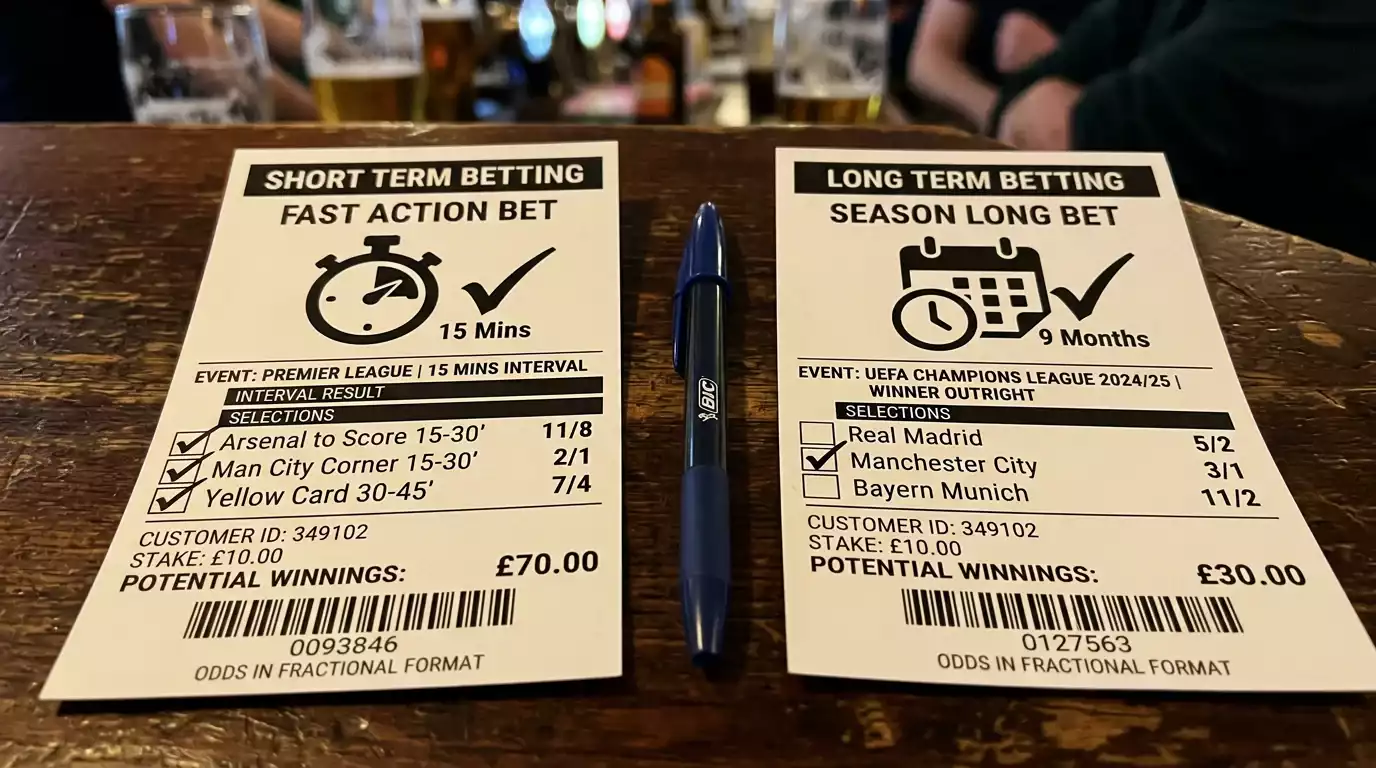
The format is straightforward: the first number represents potential profit, the second represents the stake required to earn that profit. Odds of 7/2 mean that for every two pounds you stake, you receive seven pounds in profit if the bet wins, plus your original two pounds back. Your total return is nine pounds on a two-pound stake. Odds of 1/4 mean you need to stake four pounds to win one pound in profit – a total return of five pounds. The favourite in any market will have fractional odds where the first number is smaller than the second (1/3, 2/5, 4/9), and the underdog will have odds where the first number is larger (3/1, 5/2, 9/1).
On UFC championship futures markets, you will typically see a spread from odds-on favourites at something like 4/7 for a dominant champion, through to long shots at 20/1 or higher for fighters who are several wins away from a title opportunity. Trip Stoddard, head of development at bet365, described the UFC’s year-round calendar and engaged fanbase as creating “a powerful environment for real-time betting” – and that environment produces championship odds boards that shift constantly as results come in across 43 events per year. Understanding fractional format means you can read those shifts instantly without reaching for a conversion tool.
One detail that catches out newcomers is that fractional odds on UFC futures are not always expressed in simplest form. You might see 11/8 rather than the technically equivalent but less common ratio. Bookmakers use standard fractional increments – 1/2, 4/6, 5/6, evens, 6/5, 5/4, 11/8, 6/4, 13/8, 7/4, 15/8, 2/1, and so on – because these are the intervals UK punters are accustomed to from horse racing and football. If you know these standard steps, you can gauge the size of a line movement at a glance: a shift from 7/4 to 6/4 on a championship contender tells you the market has shortened their chances noticeably.
Converting Between Fractional, Decimal, and American Formats
There are moments when conversion is unavoidable – comparing odds across an international bookmaker that defaults to decimal, or cross-referencing a US tipster’s analysis that quotes everything in American format. The conversions are mechanical, and once you have done them a few times, they become second nature.
Fractional to decimal: divide the first number by the second, then add 1. So 7/2 becomes (7 / 2) + 1 = 4.50. Odds of 1/4 become (1 / 4) + 1 = 1.25. The decimal figure represents your total return per pound staked, including the stake itself. UK bookmakers with a “decimal” toggle will show these numbers, and they are the standard format across most of continental Europe.
Fractional to American: this depends on whether the odds are greater than evens or less than evens. For odds above evens (where the first number is bigger), multiply the fractional result by 100. So 7/2 becomes +350. For odds below evens (where the second number is bigger), divide 100 by the fractional result and put a minus sign in front. So 1/4: the fractional value is 0.25, and 100 / 0.25 = 400, so the American odds are -400. Knowing this lets you interpret any UFC odds discussion regardless of the source’s native format.
Decimal to fractional: subtract 1 from the decimal, then express the result as a fraction. Decimal 3.50 becomes 3.50 – 1 = 2.50, which is 5/2. Decimal 1.80 becomes 0.80, which is 4/5. The tricky part is reducing the fraction to a standard bookmaker increment. A decimal of 2.37 converts to 1.37/1, which is not a standard fraction. In practice, the bookmaker would round to the nearest standard step – probably 11/8 (decimal 2.375) or 6/4 (decimal 2.50) depending on how they price the market.
For those who dislike mental arithmetic, 15% of UK men and 4% of UK women place sports bets regularly, and most of them rely on the bookmaker’s built-in display toggle rather than manual conversion. Every major UK platform – bet365, William Hill, Paddy Power, Ladbrokes, Betfair – lets you switch between fractional, decimal, and American with a single click. For futures markets where you need to compare across platforms quickly, setting all of them to the same format eliminates one layer of complexity from your comparison.
Calculating Futures Payouts With Fractional Odds
I keep a simple spreadsheet for every futures bet I place: the stake, the fractional odds at placement, and the implied probability. That last column is the one most bettors skip, and it is the one that matters most for assessing value.
Payout calculation is the easy part. Multiply your stake by the fractional odds and add back the stake. A ten-pound bet at 9/2 returns (10 x 4.5) + 10 = 55 pounds. A twenty-pound bet at 5/4 returns (20 x 1.25) + 20 = 45 pounds. For odds-on bets, the same formula works: a ten-pound stake at 4/9 returns (10 x 0.444) + 10 = 14.44 pounds. The maths is always the same – profit equals stake times odds, total return equals profit plus stake.
Implied probability is where fractional odds become a decision-making tool. To convert fractional odds to implied probability, use the formula: second number divided by (first number plus second number), multiplied by 100. For 7/2: 2 / (7 + 2) x 100 = 22.2%. For 1/4: 4 / (1 + 4) x 100 = 80%. This tells you the probability the market is implying for that outcome. If your own analysis puts the probability higher than the implied figure, the bet has positive expected value. If your analysis is lower, the odds are not in your favour.
On a championship futures board with eight or ten fighters listed, the implied probabilities will add up to more than 100% – that excess is the bookmaker’s margin (also called the overround or vig). A typical UFC futures market might sum to 115-125%, meaning the bookmaker has built in a 15-25% margin across the entire market. The higher the margin, the harder it is to find value. Comparing the total overround across different UK bookmakers for the same futures market tells you which platform is offering the most competitive pricing overall, even before you look at individual fighters’ odds.
For a deeper look at how these odds are constructed and what causes them to shift, the analysis of how to bet on UFC futures in the UK walks through the full process from platform selection to bet placement.
Why do most UFC odds resources use American format instead of fractional?
The UFC is headquartered in the United States, and the overwhelming majority of English-language MMA betting content is produced for a US audience. American odds format (-150, +200) is the default in the US market. UK bookmakers all support fractional display, but the educational content around UFC betting has not caught up to the UK market’s growth. Setting your bookmaker to fractional display solves the problem for your own betting, though you will still encounter American format when reading US-based analysis.
Which UK bookmakers display UFC futures in fractional odds by default?
Most UK-licensed bookmakers default to fractional odds for all markets, including UFC futures. bet365, William Hill, Paddy Power, Ladbrokes, Coral, and Betfair all show fractional as the default for UK-registered accounts. Some platforms may switch to decimal or American if you have previously changed the setting. The display format can always be toggled in account settings or directly on the odds page.
How do I quickly estimate my return from fractional UFC championship odds?
For whole-number fractions like 3/1 or 5/1, multiply your stake by the first number and add the stake back. A ten-pound bet at 5/1 returns 60 pounds. For fractions like 7/4 or 11/8, a quick mental shortcut is to round to the nearest whole number and adjust. 7/4 is close to 2/1, so a ten-pound bet returns roughly 27.50 pounds. With practice, the standard fractional steps become instinctive enough that you can estimate returns at a glance.
Published by the ufc Futures Bets team.